


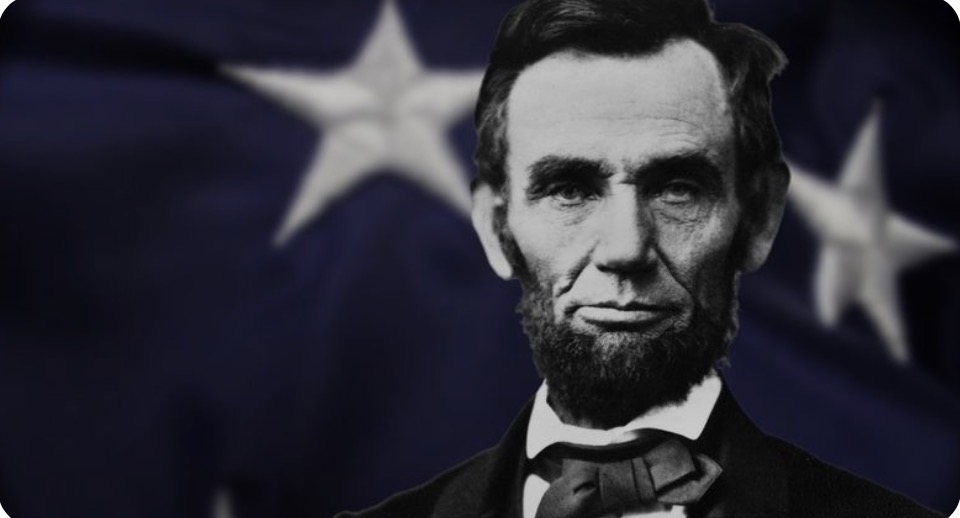
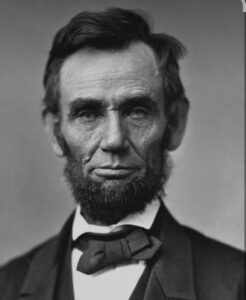
Abraham Lincoln is widely regarded as one of the most consequential leaders in American history — a self-taught lawyer from the frontier who became the 16th President of the United States, led the nation through its bloodiest war, and issued the proclamation that set enslaved people on the path to freedom. His leadership during the Civil War, and his assassination just days after the war’s end, cemented his place as one of the most studied and revered figures in world political history.
Humble Origins
Lincoln was born on February 12, 1809, in a one-room log cabin in Hardin County, Kentucky, to a poor farming family. He had less than a year of formal schooling in total, teaching himself law and rhetoric through voracious independent reading. He worked as a rail-splitter, store clerk, postmaster, and surveyor before establishing himself as a respected lawyer in Illinois.
Lincoln entered politics as a member of the Illinois state legislature and later served a single term in the U.S. House of Representatives. His political rise accelerated in the 1850s as the national debate over slavery intensified, particularly through his series of public debates with Senator Stephen Douglas in 1858, which brought him national attention despite his losing that Senate race.
Election and the Coming of War
Lincoln won the presidency in 1860 as the candidate of the newly formed Republican Party, running on a platform opposing the expansion of slavery into new territories. His election was viewed by many Southern states as an existential threat to the institution of slavery, and within months, seven Southern states seceded from the Union, forming the Confederate States of America. By the time Lincoln took office in March 1861, the nation was already fracturing, and war broke out weeks later at Fort Sumter.
Wartime Leadership
Lincoln’s presidency was consumed almost entirely by the Civil War (1861–1865), the deadliest conflict in American history. As commander-in-chief, he navigated enormous political and military challenges, cycling through generals in search of effective leadership, managing a divided public opinion in the North, and holding together a fragile coalition of Republicans, War Democrats, and border states.
Several decisions and moments defined his wartime leadership:
• The Emancipation Proclamation (1863): Lincoln declared enslaved people in Confederate-held territory to be free, reframing the war’s purpose to include the abolition of slavery and paving the way for Black Americans to serve in the Union Army.
• The Gettysburg Address (1863): In a speech lasting barely two minutes, delivered at the dedication of a war cemetery, Lincoln redefined the war as a struggle to preserve a nation dedicated to human equality, articulating ideals that continue to shape American civic identity.
• The 13th Amendment (1865): Lincoln pushed hard for the passage of the constitutional amendment formally abolishing slavery throughout the United States, securing its passage through Congress shortly before the war’s end.
Lincoln also expanded executive power in ways that remain debated by historians, including the suspension of habeas corpus in certain areas during the war — actions defended as wartime necessities but criticized by some as executive overreach.
Reelection and the War’s End
Despite significant war-weariness in the North, Lincoln won reelection in 1864, aided by decisive Union military victories. By April 1865, Confederate forces under General Robert E. Lee surrendered at Appomattox Court House, effectively ending the war and preserving the Union.
Assassination
Just five days after Lee’s surrender, on April 14, 1865, Lincoln was shot by John Wilkes Booth, a Confederate sympathizer, while attending a play at Ford’s Theatre in Washington, D.C. He died the following morning, becoming the first U.S. president to be assassinated. His death, coming at the moment of Union victory, transformed him almost immediately into a martyr figure in American memory.
Legacy
Lincoln’s influence on American and global political thought has been profound:
• He is widely credited with preserving the United States as a single nation rather than allowing its permanent division.
• The Emancipation Proclamation and his advocacy for the 13th Amendment marked pivotal steps toward the eventual abolition of slavery in the U.S.
• His rhetoric, especially the Gettysburg Address, remains a touchstone of American political language and democratic ideals.
• Lincoln is consistently ranked by historians as one of the greatest U.S. presidents, often cited as a model of pragmatic yet principled leadership under extreme pressure.
A Complicated Legacy
Modern scholarship has also examined more difficult aspects of Lincoln’s record, including his earlier, more cautious statements on racial equality, his initial willingness to prioritize preserving the Union over ending slavery outright, and his administration’s policies toward Native American tribes during the war. Serious historical assessment of Lincoln involves weighing his transformative achievements against these more contested elements.
Conclusion
Abraham Lincoln’s leadership through the Civil War remains a defining case study in how a nation can be steered through existential crisis while expanding, rather than abandoning, its founding ideals. His combination of moral clarity, political pragmatism, and personal humility continues to make him one of the most frequently studied and admired leaders in modern history.